

A groundbreaking study reveals that some of the world's richest nations are failing their citizens — while poorer countries quietly thrive
Every year, the release of the World Happiness Report triggers a familiar ritual. Pundits celebrate the Nordic countries at the top of the rankings, commentators puzzle over why wealthy nations like Japan and South Korea lag behind, and politicians from lower-income countries quietly look away. But what if the entire framework we use to measure national happiness is fundamentally flawed? That is precisely the argument made by psychologist Mohsen Joshanloo in a landmark new study published in the European Journal of Social Psychology — and his findings are forcing a long-overdue rethink of what it really means for a nation to flourish.
National life satisfaction scores — the backbone of global well-being comparisons — have one glaring blind spot: they treat a point on the happiness scale the same whether it comes from Luxembourg or Lesotho. A country where people report feeling 6.5 out of 10 on life satisfaction is ranked above one reporting 6.2, regardless of the fact that one nation has fifty times the GDP per capita of the other. This, Joshanloo argues, is a bit like judging two factories solely by their total output, while completely ignoring that one operates with a fraction of the other's resources.
The implication is profound: standard rankings don't tell us how efficiently a society converts its economic wealth into human happiness. They only tell us the final score — stripped of all context.
To correct this, Joshanloo introduces Wealth-Adjusted Life Satisfaction, or WALS — a novel measure that asks a deceptively simple question: given what a country has, how happy are its people?
Using data from the Gallup World Poll spanning 116 countries, WALS was computed by statistically removing — or "residualizing" — the effect of GDP per capita from national life satisfaction scores. What remains after stripping out the influence of wealth is a purer signal: how much happiness a country generates above or below what its economic resources would predict.
To identify patterns, the study then deployed two powerful analytical tools: Random Forest analysis, a machine-learning technique capable of ranking the importance of dozens of social variables simultaneously, and cluster analysis, which grouped countries into meaningful categories based on their WALS profiles.
The results are striking — and, at times, humbling for the world's wealthiest societies.
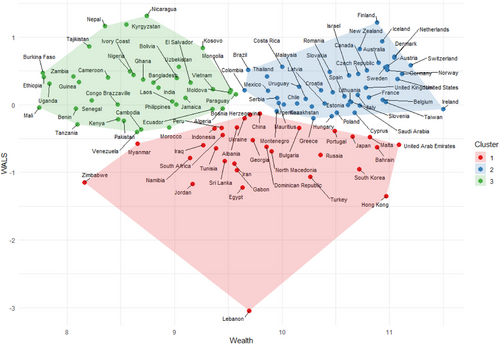
Among the overachievers — nations generating far more happiness than their GDP would suggest — the study highlights countries like Nicaragua, Nepal, and Kyrgyzstan. These are not wealthy nations by any conventional measure, yet their populations report life satisfaction levels that significantly exceed economic predictions. Something beyond money is clearly at work.
The underperformers tell an equally compelling story. Despite their extraordinary material wealth, nations like Japan, South Korea, Bahrain, and Hong Kong consistently fall short of the happiness their resources should be generating. Japan, in particular, has long puzzled well-being researchers — a paradox that WALS now frames not as a cultural curiosity, but as a measurable shortfall in converting prosperity into contentment.
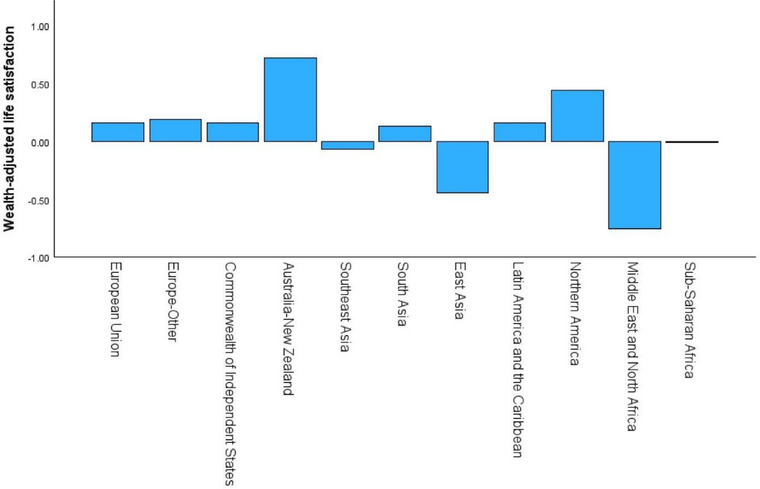
Countries in the Middle East, North Africa, and East Asia perform poorly in life satisfaction.
If wealth alone doesn't drive WALS, what does? The Random Forest analysis pointed to a cluster of social and psychological factors as the key predictors of a country's happiness efficiency:

The cluster analysis goes further, identifying a particularly remarkable group: countries that achieve high WALS despite low GDP levels — a kind of happiness elite among the world's poorer nations. The study examines what distinguishes these countries from similarly poor nations that don't share their well-being efficiency, offering a potential roadmap for development policy that prioritizes subjective flourishing alongside economic growth.
A regional breakdown also reveals patterns that cut across continents: Latin American nations, long known in the literature for their high social connectedness and expressive cultures, tend to cluster among the overachievers. East Asian economies, despite their technological sophistication and high incomes, frequently appear among the underperformers.
The study was supported by a grant from the Well-being for Planet Earth Foundation — an organisation whose very name signals the stakes. As governments worldwide grapple with questions of sustainable development, the WALS framework offers policymakers something invaluable: a diagnostic tool that distinguishes between a country that is rich and happy, one that is rich but unhappy, and one that is poor yet happy.
For the millions of people who live in nations that top the GDP charts but rank disappointingly on well-being, Joshanloo's research offers both a diagnosis and a challenge. Wealth, it turns out, is a necessary but insufficient condition for national happiness. The real question — for governments, economists, and citizens alike — is what they choose to build with it.
"Rethinking National Well-Being: Introducing a Measure of Wealth-Adjusted Life Satisfaction in 116 Countries" by Mohsen Joshanloo is published in the European Journal of Social Psychology (DOI: 10.1002/ejsp.70023).
Every year, the release of the World Happiness Report triggers a familiar ritual. Pundits celebrate the Nordic countries at the top of the rankings, commentators puzzle over why wealthy nations like Japan and South Korea lag behind, and politicians from lower-income countries quietly look away. But what if the entire framework we use to measure national happiness is fundamentally flawed? That is precisely the argument made by psychologist Mohsen Joshanloo in a landmark new study published in the European Journal of Social Psychology — and his findings are forcing a long-overdue rethink of what it really means for a nation to flourish.
The Problem With "Happy" Rankings
National life satisfaction scores — the backbone of global well-being comparisons — have one glaring blind spot: they treat a point on the happiness scale the same whether it comes from Luxembourg or Lesotho. A country where people report feeling 6.5 out of 10 on life satisfaction is ranked above one reporting 6.2, regardless of the fact that one nation has fifty times the GDP per capita of the other. This, Joshanloo argues, is a bit like judging two factories solely by their total output, while completely ignoring that one operates with a fraction of the other's resources.
The implication is profound: standard rankings don't tell us how efficiently a society converts its economic wealth into human happiness. They only tell us the final score — stripped of all context.
Enter WALS: A Smarter Metric
To correct this, Joshanloo introduces Wealth-Adjusted Life Satisfaction, or WALS — a novel measure that asks a deceptively simple question: given what a country has, how happy are its people?
Using data from the Gallup World Poll spanning 116 countries, WALS was computed by statistically removing — or "residualizing" — the effect of GDP per capita from national life satisfaction scores. What remains after stripping out the influence of wealth is a purer signal: how much happiness a country generates above or below what its economic resources would predict.
To identify patterns, the study then deployed two powerful analytical tools: Random Forest analysis, a machine-learning technique capable of ranking the importance of dozens of social variables simultaneously, and cluster analysis, which grouped countries into meaningful categories based on their WALS profiles.
The Overachievers and the Underperformers
The results are striking — and, at times, humbling for the world's wealthiest societies.
Among the overachievers — nations generating far more happiness than their GDP would suggest — the study highlights countries like Nicaragua, Nepal, and Kyrgyzstan. These are not wealthy nations by any conventional measure, yet their populations report life satisfaction levels that significantly exceed economic predictions. Something beyond money is clearly at work.
The underperformers tell an equally compelling story. Despite their extraordinary material wealth, nations like Japan, South Korea, Bahrain, and Hong Kong consistently fall short of the happiness their resources should be generating. Japan, in particular, has long puzzled well-being researchers — a paradox that WALS now frames not as a cultural curiosity, but as a measurable shortfall in converting prosperity into contentment.
Countries in the Middle East, North Africa, and East Asia perform poorly in life satisfaction.
What Actually Predicts Happiness Efficiency?
If wealth alone doesn't drive WALS, what does? The Random Forest analysis pointed to a cluster of social and psychological factors as the key predictors of a country's happiness efficiency:
- Perceived job quality — whether people feel their work is meaningful and dignified
- Sense of freedom — the degree to which individuals feel they can make choices about their own lives
- Everyday enjoyment — the simple experience of positive emotions on an ordinary day
- Social capital — the strength of trust, community bonds, and interpersonal connections
Redrawing the Map
The cluster analysis goes further, identifying a particularly remarkable group: countries that achieve high WALS despite low GDP levels — a kind of happiness elite among the world's poorer nations. The study examines what distinguishes these countries from similarly poor nations that don't share their well-being efficiency, offering a potential roadmap for development policy that prioritizes subjective flourishing alongside economic growth.
A regional breakdown also reveals patterns that cut across continents: Latin American nations, long known in the literature for their high social connectedness and expressive cultures, tend to cluster among the overachievers. East Asian economies, despite their technological sophistication and high incomes, frequently appear among the underperformers.
Why It Matters
The study was supported by a grant from the Well-being for Planet Earth Foundation — an organisation whose very name signals the stakes. As governments worldwide grapple with questions of sustainable development, the WALS framework offers policymakers something invaluable: a diagnostic tool that distinguishes between a country that is rich and happy, one that is rich but unhappy, and one that is poor yet happy.
For the millions of people who live in nations that top the GDP charts but rank disappointingly on well-being, Joshanloo's research offers both a diagnosis and a challenge. Wealth, it turns out, is a necessary but insufficient condition for national happiness. The real question — for governments, economists, and citizens alike — is what they choose to build with it.
"Rethinking National Well-Being: Introducing a Measure of Wealth-Adjusted Life Satisfaction in 116 Countries" by Mohsen Joshanloo is published in the European Journal of Social Psychology (DOI: 10.1002/ejsp.70023).
Last edited: