

A landmark new study published in Nature sheds unprecedented light on the people who lived along the old Roman frontier in southern Germany between 400 and 700 CE — and overturns some long-held assumptions about migration, marriage, and mortality in the post-Roman world.

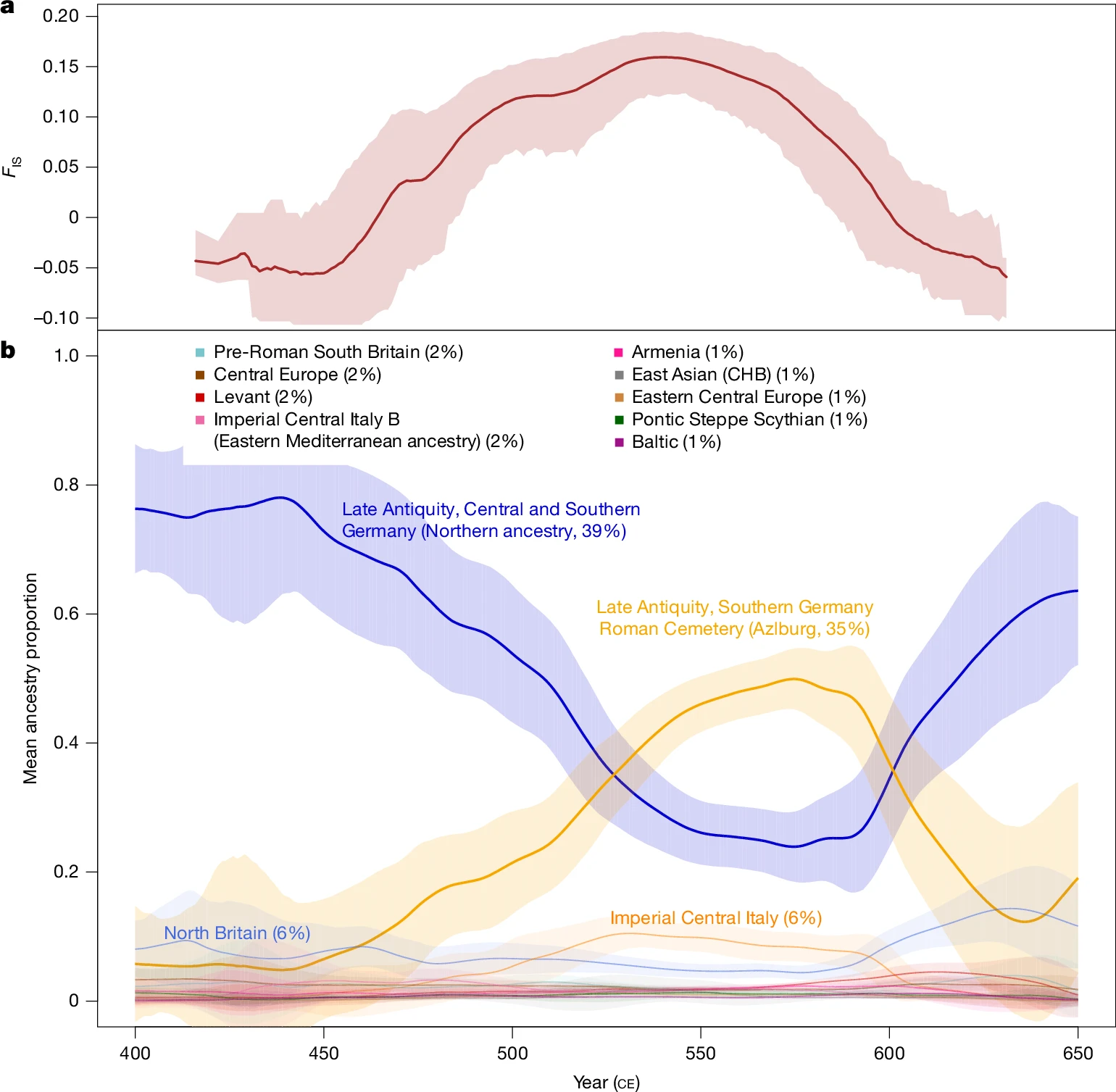
"Population genetic analyses reveal a major demographic shift coinciding with the late fifth century collapse of Roman state structures, when a founding population of northern European ancestry mixed with genetically diverse Roman provincial groups," the authors write. This mixing happened not through a single conquest, but through smaller, incremental migrations across only a few generations. Remarkably, within just 150 years of Roman administrative collapse, the population south of the old Limes frontier was already genetically similar to modern Central Europeans. By the seventh century, this resemblance was firmly established.
The researchers attribute the speed of this integration to a shared cultural background: the lifestyle and traditions of late Roman society may have acted as a social glue that facilitated rapid intermingling.
Women's shorter life expectancy compared to men is attributed by the researchers to childbirth mortality, with a notably higher death rate among females beginning around age 10. Generation time was estimated at roughly 28 years.
Childhood was not without hardship: nearly one in four children (approximately 25%) had lost at least one parent by age 10, earning them the label "half-orphans" in press coverage. Yet, counterbalancing this, an impressive 82% of children were born into families with at least one living grandparent, suggesting multi-generational support structures remained robust.
The researchers also noted that evidence of violent trauma in civilian skeletal remains from the early medieval period is significantly lower than in late Roman contexts — a possible reflection of the shift away from large-scale state-organized military campaigns toward more localized, decentralized conflicts.
The Study at a Glance
Researchers from the Universities of Tübingen, Freiburg, Mainz, and several Bavarian institutions analyzed the genomes of 258 individuals excavated from early medieval cemeteries (Reihengräberfelder) in southern Germany. Sites in Bavaria — including Weilheim, Ergoldsbach, Burgweinting, and Essenbach-Altheim — provided the skeletal material, which was also subjected to osteological analysis and strontium isotope analysis to trace geographic origins. The ancient genomes were compared against a reference dataset of 2,500 ancient and 379 modern genomes.No Great Invasion — Just Gradual Mixing
One of the study's most significant revisions to conventional wisdom concerns the nature of post-Roman settlement. The traditional narrative held that the collapse of the Western Roman Empire triggered massive, sweeping Germanic invasions that replaced the existing population. The genomic data tell a very different story."Population genetic analyses reveal a major demographic shift coinciding with the late fifth century collapse of Roman state structures, when a founding population of northern European ancestry mixed with genetically diverse Roman provincial groups," the authors write. This mixing happened not through a single conquest, but through smaller, incremental migrations across only a few generations. Remarkably, within just 150 years of Roman administrative collapse, the population south of the old Limes frontier was already genetically similar to modern Central Europeans. By the seventh century, this resemblance was firmly established.
The researchers attribute the speed of this integration to a shared cultural background: the lifestyle and traditions of late Roman society may have acted as a social glue that facilitated rapid intermingling.
Marriage, Family, and Social Norms
The study reconstructed family structures in remarkable detail. The dominant social unit was the nuclear family, and inheritance rights could pass through both daughters and sons. Most strikingly, the data provide strong evidence that lifelong monogamy was the prevailing norm:- No evidence of polygamy was found
- Remarriage by widows appears to have been rare
- No evidence of incest or close-kin marriage was detected
Life Expectancy and Childhood
Perhaps the most surprising finding concerns life expectancy. After the fall of Rome, men in southern Germany may have lived on average to 43.3 years, and women to 39.8 years — substantially longer than the 20–25 years at birth estimated for the Roman Empire period. Historians quoted in coverage of the study suggested this could reflect the health advantages of smaller, more rural communities less exposed to the crowd diseases that plagued dense Roman cities with unchlorinated water supplies.Women's shorter life expectancy compared to men is attributed by the researchers to childbirth mortality, with a notably higher death rate among females beginning around age 10. Generation time was estimated at roughly 28 years.
Childhood was not without hardship: nearly one in four children (approximately 25%) had lost at least one parent by age 10, earning them the label "half-orphans" in press coverage. Yet, counterbalancing this, an impressive 82% of children were born into families with at least one living grandparent, suggesting multi-generational support structures remained robust.
The researchers also noted that evidence of violent trauma in civilian skeletal remains from the early medieval period is significantly lower than in late Roman contexts — a possible reflection of the shift away from large-scale state-organized military campaigns toward more localized, decentralized conflicts.
Last edited:

