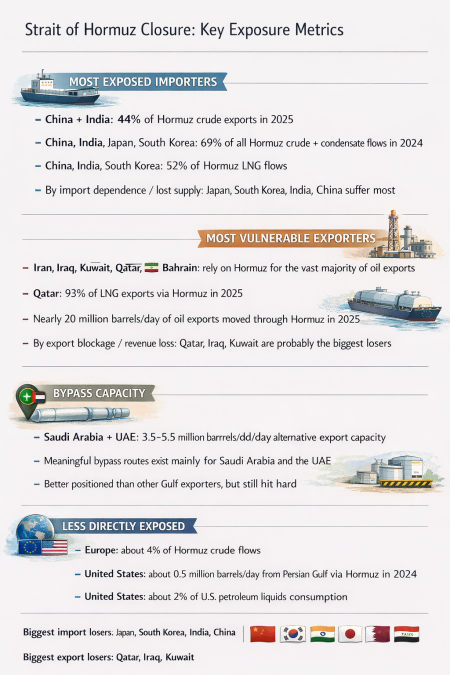
Trump said the war would end in about 6 weeks. We are currently at week 5. That aligns with the threat to destroy the power grid and water infrastructure. I predict the US will irreparably cripple Iran, and leave it in a state of chaos, while leaving the strait closed. This is also indirectly harmful to China, who takes a great deal of their oil supply from the Gulf. This will force China to purchase oil at least in part from the US to make up for the loss. I also think Israel will continue to wage war against Iran, as well as the other middle eastern states, while being heavily funded by the US.
One issue with my prediction however is the ramp up of US troops inbound for Iran. So I'm not sure when factoring that. Perhaps it will be to take and occupy the Kharg Island, as a permanent base?
Purchasing oil from the US and Canada would indeed be an option for China if oil supplies via the Strait of Hormuz ceased. The Chinese are pragmatic in matters of trade and economics, and although they consider the US their main adversary in the global geopolitical chess game, they would have no problem if North American oil were absolutely indispensable to meet their economic needs. Without an alternative, Beijing would be compelled to acquire this oil and also submit to the whims of the ever-unstable leader in Washington. Fortunately for them, there are safer options in the current global context.
First, China possesses strategic reserves of 900 million barrels, enough to cover between 78 and 100 days of net imports.
Second, Russia would be the most immediate and secure alternative, due to its land-based logistics, should China lose access to Middle Eastern oil. Russian oil arrives via pipelines that would not be affected by maritime conflicts, and Moscow is already the largest single supplier, redirecting volumes that previously went to India and Europe to the Chinese market.
Third, Brazil is seen as a strategic partner for pre-salt oils. The oil produced in the Brazilian pre-salt layer is classified as light and high-quality, Brent-type, ideal for blending in refineries. In 2025, Brazil allocated 45% of its oil exports to China, a volume that could reach 50% in 2026. The country is considered a "stable source" in the face of geopolitical volatility. Brazil broke export records in 2025, with almost half of its crude oil destined for China. Chinese refineries already prioritize Brazilian cargoes during periods of uncertainty.
Finally, China would utilize internal resources. China is by far the world's largest coal producer, generating more than half of global production (over 4.3 billion tons in 2023). Coal is the primary source of electricity and is readily available locally. On the other hand, the rapid expansion of electric vehicles (a third of new car sales) helps protect much of the transportation sector from the direct impact of oil prices.




 , I was joking at how he likes to come up with ways to make us forget the Epstein files by doing something outrageous. By better project I meant one that’s not as destructive as this war, not one that’s more effective at distracting us (and tbh this war is WAY more effective as a distractor, but I’ll take tariff threats over this war any day, especially since they can be reversed bc TACO. You can’t reverse death, and it’s harder to end a war than it is to realize your tariffs are crap and give up on them)
 !!!
!!!