
-
Don't want to see ads? Install an adblocker like uBlock Origin or use a Europe-based privacy-friendly browser like Vivaldi or Mullvad.
You are using an out of date browser. It may not display this or other websites correctly.
You should upgrade or use an alternative browser.
You should upgrade or use an alternative browser.
To burn or not to burn: LBA/EIA Balkan case
- Thread starter Southpaw
- Start date
- Status
- Not open for further replies.
PaleoRevenge
Well-known member
- Messages
- 1,529
- Reaction score
- 1,344
- Points
- 113
The data might include older samples from different countries. It is not just new data from Serbia, unfortunately.
Found the video, search "Carles Lalueza-Fox" on youtube and sort by date.
PaleoRevenge
Well-known member
- Messages
- 1,529
- Reaction score
- 1,344
- Points
- 113
Fox does not disclose the sites in the graph. Here is a higher resolution of the graph from the video:

Unless the Serbian presenter disclosed anything in the introduction, I'll agree with Riverman and take this quote as written literally:
Samples are entirely from eastern Serbia plus other regions of the Balkans. If I were to guess, Romania and Bulgaria are excluded from the table, otherwise haplogroup I would have a larger representation in BA. If Greece is excluded, the graph implies J2a was abundant in BA Serbia, bubanj-hum is probably R-Z2103 and J2a combo.
Hard to tell if they excluded Greece, maybe they did not? Locations of Roman sites.

Unless the Serbian presenter disclosed anything in the introduction, I'll agree with Riverman and take this quote as written literally:
The sites for the research of population’s genetic changes include Viminuacium, Mediana, Timacum Minus and several other sites in the Balkans, which provides a basis for the analysis of later Slavic migrations and facilitates modelling of the genetic structure of the modern Serbian population in the wider context of other Balkan people.
Samples are entirely from eastern Serbia plus other regions of the Balkans. If I were to guess, Romania and Bulgaria are excluded from the table, otherwise haplogroup I would have a larger representation in BA. If Greece is excluded, the graph implies J2a was abundant in BA Serbia, bubanj-hum is probably R-Z2103 and J2a combo.
Hard to tell if they excluded Greece, maybe they did not? Locations of Roman sites.
Last edited:
PaleoRevenge
Well-known member
- Messages
- 1,529
- Reaction score
- 1,344
- Points
- 113
Alright fellas, as always one can back into the data. I am sure Albania, MKD, Croatia, and Montengro are part of the samples. And likely Greece as well, but this one is speculation on my part. In any case, here is the awesome news.
The Serbian IA sample will be 25-28 in size (depending if public IA Greek data is included). There will be zero J2b-L283 in IA Serbia.
The J2b-L283 ratio is 20.68% in Fox's graph. That means in the graph used in the presentation there are exactly 12 J2b-L283(12/58 = 20.68), which coincidences with the tally of IA J2b-L283 in the Balkans so far. 12 is the number of Albanian and Croatian Iron Age tally for J2b-L283.
Let me repeat this, zero J2b-L283 in IA Serbia.
Here are the figures for all haplogroups in the graph, using the same method. In IA Serbia we will get:
7 E-V13
0 J2b-L283
2 J2a
7 R1b-Z2103/R1b-M269/R1b(xM269). I did not try figure out the exact breakout. I think only one will be Z2103 confirmed.
1 G
2-4 R-L51, 3 if the Cinamak is accounted correctly as PF7563, but I think they are still calling it L-51. And 4 if the Vojvodina sample is excluded too.
1 I1
1 R1a-z93
1 I2-L621
3-5 other
Cheers.
To the lurkers, beji nje selam Brumit, prej meje.
The Serbian IA sample will be 25-28 in size (depending if public IA Greek data is included). There will be zero J2b-L283 in IA Serbia.
The J2b-L283 ratio is 20.68% in Fox's graph. That means in the graph used in the presentation there are exactly 12 J2b-L283(12/58 = 20.68), which coincidences with the tally of IA J2b-L283 in the Balkans so far. 12 is the number of Albanian and Croatian Iron Age tally for J2b-L283.
Let me repeat this, zero J2b-L283 in IA Serbia.
Here are the figures for all haplogroups in the graph, using the same method. In IA Serbia we will get:
7 E-V13
0 J2b-L283
2 J2a
7 R1b-Z2103/R1b-M269/R1b(xM269). I did not try figure out the exact breakout. I think only one will be Z2103 confirmed.
1 G
2-4 R-L51, 3 if the Cinamak is accounted correctly as PF7563, but I think they are still calling it L-51. And 4 if the Vojvodina sample is excluded too.
1 I1
1 R1a-z93
1 I2-L621
3-5 other
Cheers.
To the lurkers, beji nje selam Brumit, prej meje.
Last edited:

torzio
Well-known member
- Messages
- 4,203
- Reaction score
- 1,312
- Points
- 113
- Y-DNA haplogroup
- T - L131
maybe you can calculate the numbers by.........Fox does not disclose the sites of the graph, in question. Here is a higher resolution form the video:
Unless the Serbian presenter disclosed anything in the introduction, I'll agree with Riverman and take this quote as written literally:
Samples are entirely from eastern Serbia plus other regions of the Balkans. If I were to guess, Romania and Bulgaria are excluded from that table, otherwise haplogroup I would have a larger representation in BA. If Greece is excluded, the graph implies J2a was abundant in BA Serbia, bubanj-hum is probably R-Z2103 and J2a combo.
Hard to tell if they excluded Greece, maybe they did not? Locations of Roman sites.
there are 7 .. T Ydna Neolithic samples .............4 x Harz mountain area Germany and 3 x modern Bulgaria area ( including one on the black sea )
maybe you should exclude the german ones and only use the bulgarian ones as they are balkan
PaleoRevenge
Well-known member
- Messages
- 1,529
- Reaction score
- 1,344
- Points
- 113
maybe you can calculate the numbers by.........
there are 7 .. T Ydna Neolithic samples .............4 x Harz mountain area Germany and 3 x modern Bulgaria area ( including one on the black sea )
maybe you should exclude the german ones and only use the bulgarian ones as they are balkan
Read my post above yours and enjoy mate, G'day.
PaleoRevenge
Well-known member
- Messages
- 1,529
- Reaction score
- 1,344
- Points
- 113
I did a quick cross check for the Bronze Age. The BA ratio for J2b-L283 in the graph is 18.44%, which equates to 24 J2b-L283 (131 x .1844). This is the exact number of BA J2b-L283 from Croatia through Albania. They are excluding the J2b from the Mokrin sample, which implies all BA Serbian samples north of the Danube are excluded too. Or they are excluding the Albanian BA samples. I am assuming they are excluding the Vojvodina samples.
If that assumption holds, In BA Serbia, south of the Danube, we will get 0 R-L51, 0 J2b-L283, 6 J2a, 10 R-Z2103, 11 R-M269, and maybe 1 E-V13 if that exaggerated thick line between J2b and R1a is indeed a singular E-V13 stripe. I didn't look into other haplos, because they are outside my interest. Also the Serbian BA sample will be about 65 (n=65). For BA it looks like they are excluding Greece, if so J2a will be higher and the sample size from Serbia will be around 80.
This data dump will be glorious.
If that assumption holds, In BA Serbia, south of the Danube, we will get 0 R-L51, 0 J2b-L283, 6 J2a, 10 R-Z2103, 11 R-M269, and maybe 1 E-V13 if that exaggerated thick line between J2b and R1a is indeed a singular E-V13 stripe. I didn't look into other haplos, because they are outside my interest. Also the Serbian BA sample will be about 65 (n=65). For BA it looks like they are excluding Greece, if so J2a will be higher and the sample size from Serbia will be around 80.
This data dump will be glorious.
Last edited:
Keep in mind that the total number of new Iron Age samples is pretty low, so the E-V13 might be from all kinds of sites. I think it was debated on AG some time ago and it doesn't look too good for Basarabi samples, which would be truly a shame for a Serbian paper which includes the Iron Age period.
From AG:
https://anthrogenica.com/showthread...ve-been-Dacian&p=906791&viewfull=1#post906791
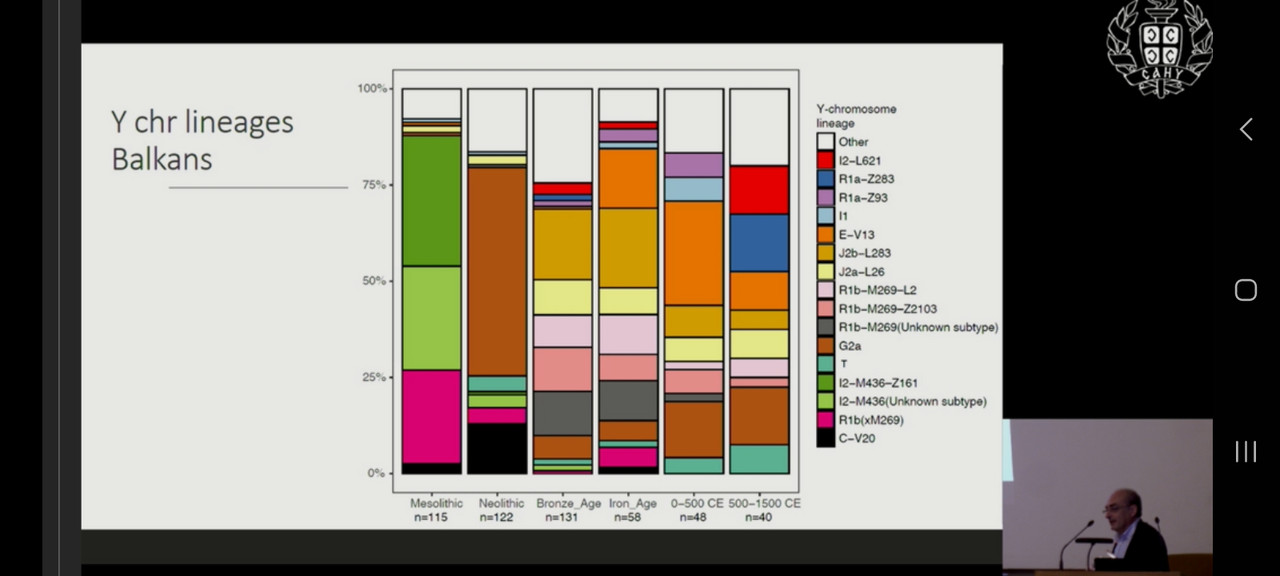
i see this graph is causing some confusion in the thread.
These results aren't exclusively from Serbia, they are from the entire Balkans, compiled from all available studies.
Most of them are already published.
the % of E-V13 from the IA equals around 10 samples, which are simply the ones from Kapitan Andreevo.
0-500 CE is mostly the Viminacium and Timacum ones.
the J2b2 are mostly the ones from Croatia we already know of.
my guess is that either IA Serbia will be mostly R1b-Z2103, or we won't get any IA samples from central Serbia at all.
https://anthrogenica.com/showthread...ve-been-Dacian&p=906791&viewfull=1#post906791
PaleoRevenge
Well-known member
- Messages
- 1,529
- Reaction score
- 1,344
- Points
- 113
I see what he is saying, but I am 100% certain Bulgaria is excluded, use the higher resolution image I provided and paste it into Microsoft paint. Then measure the pixel distances.
Let me demonstrate: The entire graph bar has a pixel height of 640. In IA for example the E-V13 pixel is 100. So ratio times total sample size (100/640 x 58) = 9.0625 = 9. We have to round, as this is image based calc. Slavomir is close but incorrect. There are 9 E-V13 in the Southern Arc paper only from Bulgaria IA alone, plus one MKD and one Croatia, a total of 11 in IA Balkans only from Southern Arc. I am certain Bulgaria is excluded, because you can test out the same method for the Bronze Age, where haplogroup I2-L621 equals to be a total of 4 individuals. You guys should crosscheck my work, as I don't know what falls under this haplogroup, I do know there is tons of I2 in BA Romania and Bulgaria, and the figure of 4 seems extremely low if this is all inclusive Balkan samples.
Plus I am using the presenters hint from one of his slides. For the AD comparison analysis, Fox's additional samples come from Croatia-Bosnia-Montenegro-Albania-MKD-Greece. They are not consistent, because they did leave out Montenegro Dioclea AD samples (which I am sure for the BA period they did not leave out), in any case this is the general geographical focus they seem to be using.
So, there are only 9 E-V13 in the graph, one is likely Croatia, and one is MKD, this leaves 7 for Serbia.:bigsmile:
Last edited:
torzio
Well-known member
- Messages
- 4,203
- Reaction score
- 1,312
- Points
- 113
- Y-DNA haplogroup
- T - L131
I see what he is saying, but I am 100% certain Bulgaria is excluded, use the higher resolution image I provided and paste it into Microsoft paint. Than measure the pixel distances.
Let me demonstrate: The entire graph bar has a pixel height of 640. In IA for example the E-V13 pixel is 100. So ratio times total sample size (100/640 x 58) = 9.0625 = 9. We have to round, as this is image based calc. Slavomir is close but incorrect. There are 9 E-V13 in the Southern Arc paper only from Bulgaria IA alone, plus one MKD and one Croatia, a total of 11 in IA Balkans only from Southern Arc. I am certain Bulgaria is excluded, because you can test out the same method for the Bronze Age, where haplogroup I2-L621 equals to be a total of 4 individuals. You guys should crosscheck my work, as I don't know what falls under this haplogroup, I do know there is tons of I2 in BA Romania and Bulgaria, and the figure of 4 seems extremely low if this is all inclusive Balkan samples.
Plus I am using the presenters hint from one of his slides. For the AD comparison analysis, Fox's additional samples come from Croatia-Bosnia-Montenegro-Albania-MKD-Greece. They are not consistent, because they did leave out Montenegro Dioclea AD samples (which I am sure in BA they did not leave out), but that is the general geographical focus they seem to be using.
So, there are only 9 E-V13 in the graph, one is likely Croatia, and one is MKD, this leaves 7 for Serbia.:bigsmile:
it says
Additional Balkan sites ........................means additional to the video presenting Y lineages balkan video
PaleoRevenge
Well-known member
- Messages
- 1,529
- Reaction score
- 1,344
- Points
- 113
it says
Additional Balkan sites ........................means additional to the video presenting Y lineages balkan video
A summary of the lecture by the host organization:
A several-year-long study on the origin of the Balkan people has revealed that about a half of today’s Serbian population’s genomes is indigenous, at least up to the Bronze age, whereas the remaining half is of Slavic origin, descendant from the Slavic migrants in the 7th century. Therefore, Slavic migration to the Balkans did not bring about population replacement, but an admixture of indigenous Balkan genome and the genome of Slavic migrants. Molecular markers have suggested that the Slavic migrations to the Balkans could have originated from present-day Poland and Ukraine. This study analyses the genetic structure of the local people in the region of Serbia in the Bronze, Iron, Roman and post-Roman period, and the present-day population. This continuity in the analysis has paved the way for identifying the constancy of population in our region and the DNA proportion in today’s modern population with lineage traced back to ancient history. The sites for the research of population’s genetic changes include Viminuacium, Mediana, Timacum Minus and several other sites in the Balkans, which provides a basis for the analysis of later Slavic migrations and facilitates modelling of the genetic structure of the modern Serbian population in the wider context of other Balkan people.
https://www.sanu.ac.rs/en/lecture-on-slavic-migrations-and-the-origin-of-people-in-the-balkans/
Viminuacium, Mediana, Timacum Minus are the Serbian sites, and cannot be additional, the creator of the slide was being sloppy, that's all. Should have typed Serbian and additional Balkan sites. Let's not focus on a mundane point though.
PaleoRevenge
Well-known member
- Messages
- 1,529
- Reaction score
- 1,344
- Points
- 113
Zero J2b-L283 and a strong presence of E-V13 is not a minor victory. It's a pretty damn good blow, it will provide the fanatics a tiny bit of hope (after a week of depression) to only be struck down again by another future blow.
We don't know the context here at all, are these IA samples entirely from northern Serbia(Sirmium), or are the Celtic-Sarmatian-Germanic halpogroups from Sirmium and the E-V13 and R-Z2103 from Triballi area. If the later is true, the blow will be final to the zealots, there is no hope at all from the later scenario.:bigsmile:
We don't know the context here at all, are these IA samples entirely from northern Serbia(Sirmium), or are the Celtic-Sarmatian-Germanic halpogroups from Sirmium and the E-V13 and R-Z2103 from Triballi area. If the later is true, the blow will be final to the zealots, there is no hope at all from the later scenario.:bigsmile:
PaleoRevenge
Well-known member
- Messages
- 1,529
- Reaction score
- 1,344
- Points
- 113
Alright, I can see people think I am speaking Japanese here. Here is a demo on how to do it yourself.
1) First step is to copy and paste the graph into MS Paint.
2) Click on the select button.

With that feature you can measure the pixel heights, see example below.

Slavomir is on the right track, visually there are roughly 10 E-V13, but if you measure it there are exactly 9, (100/640) x 58 = 9.0625 which rounds to 9.
We can back into any haplogroup that is listed there. For the reasons previously explained, I am certain Bulgaria is excluded.
1) First step is to copy and paste the graph into MS Paint.
2) Click on the select button.
With that feature you can measure the pixel heights, see example below.
Slavomir is on the right track, visually there are roughly 10 E-V13, but if you measure it there are exactly 9, (100/640) x 58 = 9.0625 which rounds to 9.
We can back into any haplogroup that is listed there. For the reasons previously explained, I am certain Bulgaria is excluded.
PaleoRevenge
Well-known member
- Messages
- 1,529
- Reaction score
- 1,344
- Points
- 113
Having chatted with the one of the Serb users in Anthrogenica, they are convinced the math does not add up because some E-V13 are not called as E-V13 (classified as "other"). And a similar argument was made for I2-L621. Performing the same test on the other category, only 5 haplogroups readings belong to other.
However I have my doubts. Here is E-V13 from southern Arc (without E-M78):

There are still 10 E-V13, which is over the correct threshold of 9. If one is to exclude the E-L618 than we are down to 7, and 2 additional E-V13s have to be accounted for. If the Serbian data is restricted to the Danubian frontier only, Fox's graph is mathematically incorrect. Also note that if 3 E-L618 and the 1 E-M78 are excluded, 4 out of 5 slots for the other category are already used up, this explanation seems suspect since it is likely there other basal clades that fall into the other category for other haplogroups, and capacity is only 5, with 4 already theoretically used up. Math will likely not work.
Similar situation exists with BA I2-M436 and I2-M436 unknown, which according to the presentation should only be 2. However the southern Arc paper shows 7. This is a huge gap.

The assumption that the graph includes all the Balkans seems incorrect. Even the visual slide of the sites from Roman period excluded the Bulgarian (Boynovo) sample. The updated paper might very well include all the Balkans, but the data that was used in the presentation cannot have been. I would not rule out samples from IA Serbia being part of these charts and being part of the revised paper.
However I have my doubts. Here is E-V13 from southern Arc (without E-M78):
There are still 10 E-V13, which is over the correct threshold of 9. If one is to exclude the E-L618 than we are down to 7, and 2 additional E-V13s have to be accounted for. If the Serbian data is restricted to the Danubian frontier only, Fox's graph is mathematically incorrect. Also note that if 3 E-L618 and the 1 E-M78 are excluded, 4 out of 5 slots for the other category are already used up, this explanation seems suspect since it is likely there other basal clades that fall into the other category for other haplogroups, and capacity is only 5, with 4 already theoretically used up. Math will likely not work.
Similar situation exists with BA I2-M436 and I2-M436 unknown, which according to the presentation should only be 2. However the southern Arc paper shows 7. This is a huge gap.
The assumption that the graph includes all the Balkans seems incorrect. Even the visual slide of the sites from Roman period excluded the Bulgarian (Boynovo) sample. The updated paper might very well include all the Balkans, but the data that was used in the presentation cannot have been. I would not rule out samples from IA Serbia being part of these charts and being part of the revised paper.
Last edited:
PaleoRevenge
Well-known member
- Messages
- 1,529
- Reaction score
- 1,344
- Points
- 113
Another example why Bulgaria cannot have been part of those charts. Let's look at BA R1bs.
The graph says there are 11 L-51s. We have 9 from Bezdanjaca cave, 1 in Cetina and 1 from either Mokrin, or Bulgaria, can't have both, as it would go over the threshold. A study focusing on Serbia likely includes Mokrin and excludes Bulgaria.
Now the sample size for R-Z2103 and R-M269(excluding L51) is 30 according to the graph. There are 13 such haplos in southern Arc (I am even including Moldova here), 1 Vucedol and 4 Mokrin. At best we have 18 accounted for. If I discount Moldova or/and Bulgaria, the gap grows even larger and larger. This is a study focused on Serbia, and the only reasonable explanation is, excess samples come from Serbia.

The same problem exists for IA chart, there is excess R-2103, M-269, L-51, there is even I1, etc.... I find it highly unlikely that all these excess samples/haplogroups can come from Serbia(undisclosed samples) but the E-V13 is attributed to Bulgaria. The reasonable explanation is, Bulgaria is not part of the comparative chart used by Fox.
There will also be one E-V13 coming out of Bronze Age Serbia.
The graph says there are 11 L-51s. We have 9 from Bezdanjaca cave, 1 in Cetina and 1 from either Mokrin, or Bulgaria, can't have both, as it would go over the threshold. A study focusing on Serbia likely includes Mokrin and excludes Bulgaria.
Now the sample size for R-Z2103 and R-M269(excluding L51) is 30 according to the graph. There are 13 such haplos in southern Arc (I am even including Moldova here), 1 Vucedol and 4 Mokrin. At best we have 18 accounted for. If I discount Moldova or/and Bulgaria, the gap grows even larger and larger. This is a study focused on Serbia, and the only reasonable explanation is, excess samples come from Serbia.
The same problem exists for IA chart, there is excess R-2103, M-269, L-51, there is even I1, etc.... I find it highly unlikely that all these excess samples/haplogroups can come from Serbia(undisclosed samples) but the E-V13 is attributed to Bulgaria. The reasonable explanation is, Bulgaria is not part of the comparative chart used by Fox.
There will also be one E-V13 coming out of Bronze Age Serbia.
Last edited:

Southpaw
Regular Member
- Messages
- 2,618
- Reaction score
- 1,424
- Points
- 113
- Ethnic group
- Albanian
- Y-DNA haplogroup
- E-V13
1 E-V13 in Bronze Age Serbia would be interesting considering Vatin, Dubovac-Zuto Brdo, Paracin Brnjica are cultures known to extensively cremate their deaths.
Also one addition regarding the debate of South-East Bulgarian E-V13, funny enough that culture is called as Eastern Hallstattian and its origin is usually tied to North-Western Bulgaria or Southern Carpathians/Oltenia by various archaeologists. Obviously they are not descended from Gava but rather from the same cultural block as them, they were their southern cousins. Whether Gava had E-V13, that i don't know. But, Gava and it's southern cousin cultures Psenicevo, Babadag and Insula Banului is what is considered to have consisted the Daco-Thracian ethnos. So, putting the E-V13 from Kapitan Andreevo ancestors so south or so north doesn't work considering archaeology is quite clear they must come from the territory consisting between the borders of present Romania, Bulgaria, Serbia and Hungary.
Also one addition regarding the debate of South-East Bulgarian E-V13, funny enough that culture is called as Eastern Hallstattian and its origin is usually tied to North-Western Bulgaria or Southern Carpathians/Oltenia by various archaeologists. Obviously they are not descended from Gava but rather from the same cultural block as them, they were their southern cousins. Whether Gava had E-V13, that i don't know. But, Gava and it's southern cousin cultures Psenicevo, Babadag and Insula Banului is what is considered to have consisted the Daco-Thracian ethnos. So, putting the E-V13 from Kapitan Andreevo ancestors so south or so north doesn't work considering archaeology is quite clear they must come from the territory consisting between the borders of present Romania, Bulgaria, Serbia and Hungary.
1 E-V13 in Bronze Age Serbia would be interesting considering Vatin, Dubovac-Zuto Brdo, Paracin Brnjica are cultures known to extensively cremate their deaths.
Also one addition regarding the debate of South-East Bulgarian E-V13, funny enough that culture is called as Eastern Hallstattian and its origin is usually tied to North-Western Bulgaria or Southern Carpathians/Oltenia by various archaeologists. Obviously they are not descended from Gava but rather from the same cultural block as them, they were their southern cousins. Whether Gava had E-V13, that i don't know. But, Gava and it's southern cousin cultures Psenicevo, Babadag and Insula Banului is what is considered to have consisted the Daco-Thracian ethnos.
I wrote about that in my latest posts:
https://anthrogenica.com/showthread...ve-been-Dacian&p=907023&viewfull=1#post907023
https://anthrogenica.com/showthread...ve-been-Dacian&p=907039&viewfull=1#post907039
These were in my opinion all Pre-G?va and G?va cultures. Like I wrote about the axes of Male Vrbica before and the Vartop group etc. They are expansions of Channelled Ware on top of Encrusted Pottery (Vartop). Some highlights with examples once more:
The Psenichevo and Babadag pottery show the biggest parallels, and I posted some examples - nobody in a clear state of mind can put those prestige products in any pre-Channelled Ware context from Bulgaria! Never!
Put them side by side with G?va, Lapus II-G?va and Belegis II-G?va, and they fit in.
Knobbed Ware distribution - completely covered Bulgaria:

From:
From: https://d-nb.info/976420309/34
Basarabi it's mostly derived from Insula Banului and as such was more influenced by the Hallstat groups unlike the Thracian groups in Bulgaria.
Nevertheless the main horizon behind the spread of the Thracian ethnicity is the Stamped Ware and it's perfectly clear where was it's core, Thrace, northern Bulgaria, Dobrugia, Moldova, Oltenia.
It's only after the Stamped Ware horizon, it's descendant the Basarabi group spread in Transylvania and elsewhere.
The stamps are a later introduced variation to the established canon we know from Babadag and Channelled Ware, which established itself in Psenichevo. Look at the early pottery of Psenichevo and nobody can deny the G?va influence. They are directly evolving from the Babadag and Fluted Ware horizon at the Lower Danube.
I posted it once, I post it again - pieces from Bulgaria and Troy:
https://pbs.twimg.com/media/FIl30RMXsAQlLEn?format=jpg&name=large
That is Babadag and Psenichevo prestige pottery with channelling and knobs:

From Elena Bozhinova, p. 70 and 71:
https://www.academia.edu/7794465/Thrace_between_East_and_West_the_Early_Iron_Age_Cultures_in_Thrace
Compare with Lapus II-G?va:

Metzner-Nebelsick page 77:
https://www.academia.edu/3195938/Ch...a_and_beyond_ritual_and_chronological_aspects
What culture in Bulgaria did produce that before the invasions from the Carpathian cremation block? Which one?
Which did persist Noua-Coslogeni and Channelled Ware? Even Incised Pottery came from the Danube, from groups which combined Noua-Coslogeni, Belozerka and G?va-related elements. The exact origin of the addition of stamps is unclear and it was just added to the canon anyway.
In the end Basarabi became dominant, which was, like you said yourself, from a much more G?va/Belegis II-G?va influenced region.
Bulgaria was covered by Fluted Ware:

From Elena Bozhinova, p. 70 and 71:
https://www.academia.edu/7794465/Thrace_between_East_and_West_the_Early_Iron_Age_Cultures_in_Thrace
And what phenomenon is in the end crucial for Bulgaria, what are we talking about? Psenichevo and Basarabi. So its just about how those two came up and both show strong relations with the Thracian Hallstatt sphere and just look at the early Psenichevo prestige pottery, just look at it! Any researcher which claims that this is not related to G?va, Lapus II-G?va and Belegis II-G?va is just in denial, that's just living in denial! There is nothing like that in Bulgaria and again, its not just the pottery, its many other things as well, like the complete metal production and repertoire shifts towards the Carpatho-Balkan groups.
Why do you think the Stamped Pottery spread so easily? Because it could rely upon already established networks created by Channelled Ware, its the same regions affected, only those North of the Cimmerian/Mezocsat wedge are not initially!
Fluting/cannelure being never abandoned in Psenichevo, just stamps added:
The upper Early Iron Age layers at Malkoto kale and Ada Tepe II, and the lower layers at Cala and Psenicevo itself belong to the second stage, which marks the apogee of geometric ornamentation.53 Most used are the stamped motifs, among which the S-ornaments are generally preferred. Combinations of stamped decoration and flutes are often seen.
I would rather question Babadag, because it has more Noua and Belozerka influences, than Psenichevo, which is just a continuation of Fluted/Knobbed Ware variation with new Babadag/Belozerka and Aegean/Anatolian motifs added.
How can anybody say Bulgarian Fluted Ware is not related to G?va or even more absurd, Psenichevo is a completely different group from Fluted Ware? Absurd. Even more since there are many more aspects to it, like the metal production and tools, with Bulgaria being flooded from the Carpathian basin and cut off from Greece-Anatolia during the Fluted Ware/Knobbed Ware expansion.
PaleoRevenge
Well-known member
- Messages
- 1,529
- Reaction score
- 1,344
- Points
- 113
Per Anthrogenica post, Fox informed Pribislav that the Danubian paper(from July 2021) was being revised(as of July 2022 to include more data). By the sound of it, they were only months away from submitting it to a journal and we might see it this year. This also explains why the Mokrin paper is stuck in preprint despite being introduced in 2020.
This is my revised haplogroup prediction that will come from the revised paper.
Iron Age Serbia:
7 E-V13 (0 if Bulgaria is included)
0 J2b-L283
2 J2a
2 R-Z2103
2-3 R-M269
2 R-xM269
1 G2a
3 R-L51 (one in southern Arc, 2 new)
1 I1
1-2 R1a-Z93 (2 if Bulgaria is excluded)
1 I2-L621
3 other (0 if Bulgaria E-M78s are included)
Bronze Age Serbia:
1 E-V13
1 J2b-L283 (Mokrin/Maros, 0 new)
13 R-Z2103 (includes 5 from Mokrin/Maros, 8 new)
11 R-M269
0 R1b(xM269)
1 R-L51 (Mokrin/Maros, 0 new)
9 J2a
0 G2a
2 I-L621
2 R1a-Z283
2 R1a-Z93
2 I2-M436 (Mokrin/Maros and Iron Gates, 0 new)
1 R1b (xM269)
and about 13 other, 4 of these are I2(M423) from Mokrin, and 2 of these are BT, also from Mokrin. That leaves 7 unknown haplogroups.
G2a tally looks out of wack, but they are excluding the Vucedol ones, considering them neolithic, including BA Greece, but excluding Minoan. It's the only way the math works.
From this I conclude that Z-2103 was mixed in Mokrin with haplogroup I2, and mixed in Bubanj with J2a, while in-between was a more purer reservoir for Z-2103.
The E-V13 is probably LBA, Belegis II, hard to know without any context given for the samples. We will just have to wait for the data.
This is my revised haplogroup prediction that will come from the revised paper.
Iron Age Serbia:
7 E-V13 (0 if Bulgaria is included)
0 J2b-L283
2 J2a
2 R-Z2103
2-3 R-M269
2 R-xM269
1 G2a
3 R-L51 (one in southern Arc, 2 new)
1 I1
1-2 R1a-Z93 (2 if Bulgaria is excluded)
1 I2-L621
3 other (0 if Bulgaria E-M78s are included)
Bronze Age Serbia:
1 E-V13
1 J2b-L283 (Mokrin/Maros, 0 new)
13 R-Z2103 (includes 5 from Mokrin/Maros, 8 new)
11 R-M269
0 R1b(xM269)
1 R-L51 (Mokrin/Maros, 0 new)
9 J2a
0 G2a
2 I-L621
2 R1a-Z283
2 R1a-Z93
2 I2-M436 (Mokrin/Maros and Iron Gates, 0 new)
1 R1b (xM269)
and about 13 other, 4 of these are I2(M423) from Mokrin, and 2 of these are BT, also from Mokrin. That leaves 7 unknown haplogroups.
G2a tally looks out of wack, but they are excluding the Vucedol ones, considering them neolithic, including BA Greece, but excluding Minoan. It's the only way the math works.
From this I conclude that Z-2103 was mixed in Mokrin with haplogroup I2, and mixed in Bubanj with J2a, while in-between was a more purer reservoir for Z-2103.
The E-V13 is probably LBA, Belegis II, hard to know without any context given for the samples. We will just have to wait for the data.
Last edited:
- Status
- Not open for further replies.