• Don't want to see ads? Install an adblocker like uBlock Origin or use a Europe-based privacy-friendly browser like Vivaldi or Mullvad.

The Neolithic Transition in the Baltic Was Not Driven by Admixture with Early Europea

Good points from Anthrogenica:

alan said:
rms2 said:
Where did all that R1b hide during the Neolithic?


P297, M269 etc did not expand barely at all above bare survival until the steppe branch took off around 4000BC and the indeed the branch that covers most of Europe L23-L51-L11 also did not apparently expand above bare survival levels until L11 probably little before 3000BC. That clearly places them in a non-farmer area before those dates because we dont see the branching that the benefits of the huge increase in population farming would permit. There are not many areas of Europe (except really tiny pockets) where farming had not penetrated by 4000BC and very few by 3000BC and the only large blocks where farming barely grazed the economy were the steppe and north-east Europe areas.

Now that is established I firmly believe P297 was located in that zone as of course would its early M269 and other main branch. The presence of P297 is of course now proven in late hunters in the Baltic and Volga areas. Now what archaeological element do the hunters in both NE Europe and the steppes have in common?
This is key IMO. Ukraine and south Russia, the Carpathians, Balkans etc did not host cultures which are traced back through the chain to the western Magdallenians (I looked heavily into this). Western Europe did, west-central Europe did, north-central Europe did, the Baltics did, Scandinavia did and the extreme NW of Russia did. So the western strand of hunters is not a common denominator between P297 late hunters of NE Europe and the P297 Volga hunters who are both proven by ancient DNA. So P297 did not come to those areas with the hunters spreading across Europe from the south-western refugia.

Conversely the epiGravettian was known in Italy, Balkans, Carpathians, Ukraine etc but never sent offshoots north into NE Europe where this P297 was found. The latest ideas about cultures like the Swiderian is that they are from the west ultimately from the Magalenian tradition.So the epigravettian is also not the common denominator for the P297 hunters found in ancient DNA in the Volga and Baltic.

So what is the common denominator of the two areas of eastern Europe where P297 hunters are proven to be located in the late Mesolithic? Well there are two options. One is the pressure flaked microblades which spread in an east-west cline through part of Europe. They are earliest in the Urals around 9500BC, they appear in the Baltic by 8000BC? They made it as far as the German-Danish border area by 7000BC. To the south, it seems the spread across to the Ukraine-Moldova border was a little slower in moving and took place by 7500BC (although this is from memory).

The main other option is pointed based pottery which also has an east to west dating cline across Europe. I read up on this a year or so ago but all I can remember is the best dating indicates its later - was it around 6000BC? pointed pot could also be responsible for the spread of P297 but that could be ruled out if the earliest attested P297 predates the arrival of the pointed pottery in that area. I have been too busy to check this. Jean? I remember checking the chronology of the steppe P297 hunter and pointed pot in the area and he did not predate the spread of pointed pot up his bit of the Volga.

The western boundary of the spread of microblades was roughly from NW Germany-Denmark to the Ukraine-Moldova boundary. The western boundary of the spread of pointed pot was similar although there was a slight coastal extension to the Rhine mouth. Draw a line from the Low Countries to Moldova and east and north of that IMO was the zone where P297 lived before 3000BC.

The bigger picture is this appear to link P297 with two technological spreads in the Mesolithic which probably passed through south Siberia first as there are far older dates for both there. This of course is not only all post-LGM infusion of new elements into Europe but its post-Younger Dryas and essentially what would be called the Mesolithic in the west. I do not believe that P297 will be found in pre-Younger Dryas hunters anywhere in Europe.

As a sidenote, it is also worth noting that pressure flaked microblades appeared in the north of south-west Asia (Iran, south Caucasus fringe etc) around the end of the Younger Dryas almost simultaneously to their first footfall in Europe in the Urals. This IMO could be the signal of how the P25xP297 got into that area from north central Asia/south Siberia. That Stan area of north central Asia was a cool desert at the time and the most likely way of crossing to the north of SW Asia would surely be to use the Caspian's eastern shore.
 
Good points from Anthrogenica:

quote_icon.png
Originally Posted by rms2
Where did all that R1b hide during the Neolithic?

The genetics related question is the same as the following anthropological fact, isn't it?

Debetz (1936), and Alexeev and Gokhman (1987) identified a so-called CroMagnon variety among the Bronze and Iron Age skeletal materials of European Russia and southern Siberia. This variety that combined the cranial robustness with a broad face, had its roots in the local Upper Palaeolithic

-
Antropologia, E.N. Chrisanfova, I.V. Perevozchikov, 2005 : PaleoEuropid type spread in steppe zone of Eurasia from Dnieper to Altaye-Sayan region in 3-2 milleniums B.C.

http://www.eupedia.com/forum/thread...-with-Early-Europea/page9?p=501145#post501145 (#203)
 
TO try to go closer to reality is not a sin, and honest scientists can do it, pace by pace, for the most in using pluridisciplinary methods -

the problem is some scientists and some more numerous "amateurs" are biased...

First part: hear, hear!

Second part: we are all, scientist or not, biased. In historical matters is objectivity something different than for a natural scientist or mathematician. Subjectivity is always the case. It's like a painter who paints a painting. The painting can give a detailed image of reality, as close as it gets, but never equals reality.


Sent from my iPad using Eupedia Forum
 
First part: hear, hear!

Second part: we are all, scientist or not, biased. In historical matters is objectivity something different than for a natural scientist or mathematician. Subjectivity is always the case. It's like a painter who paints a painting. The painting can give a detailed image of reality, as close as it gets, but never equals reality.


Sent from my iPad using Eupedia Forum

in nature and maths, there is no room for bias

social studies which today are produced by the dozen, I'd say are 95 % ruled by bias

history, archeology are somewhere in the middle
in history, archeology more objective proof is available than in social and enveronmental studies
but always there remains room for interpretation
 
What's the evidence for P297 emerging at the Urals anyway? All of this sounds very speculative.
 
First part: hear, hear!

Second part: we are all, scientist or not, biased. In historical matters is objectivity something different than for a natural scientist or mathematician. Subjectivity is always the case. It's like a painter who paints a painting. The painting can give a detailed image of reality, as close as it gets, but never equals reality.


Sent from my iPad using Eupedia Forum

to me "biased" is strongest than "subjective" - I can suffer of a bit of subjectivity but I'm not biased - in my life i have been obliged to change my prejudices according to reality, even if it was not pleasant - by the way, concerning FAR IN PAST History I had NO prejudice, only curiosity - you can see that by reading some of my posts where I admit my confusion or uncertainty (sorry for my "french" english) and where sometimes - as do some others - I propose more than a "solution" - sometimes I have NO solution...
As you know perhaps I am not interested in comparisons about "levels" or superiority/inferiority between populations, not that I say everybody is "equal" but I am not interested in this stuff - my ancestors were diverse as for others and I suppose they were not holly people or noble people or Nobel prized people all of them, if any. I find more pleasure like that, without anything to prove.
You are not obliged to believe me, of course!
Good evening all the way!
 
in nature and maths, there is no room for bias

social studies which today are produced by the dozen, I'd say are 95 % ruled by bias

history, archeology are somewhere in the middle
in history, archeology more objective proof is available than in social and enveronmental studies
but always there remains room for interpretation

Agree but room for interpretation is not the same as twisting or discarding "unfitting" elements. Concerning social studies I agree: often more politic than science, it's why I seldomly look at the threads concerned by them -
-
 
Agree but room for interpretation is not the same as twisting or discarding "unfitting" elements. Concerning social studies I agree: often more politic than science, it's why I seldomly look at the threads concerned by them -
-

it's what a told before

this room of interpretation is abused all the time by 'serious' politicians who argue with 'scientific' studies
it's not so dificult for them to find a friended 'scientist' who will write a paper acording to their requirements
 
Interesting given what we've been discussing, yes? Some scientists obviously want to clean up the process, thank goodness.

"#SLAS2017 Bioinformatics at @bmsnews adopted the @PLOS editorial's "10 simple rules for reproducibility" http://journals.plos.org/ploscompbiol/article?id=10.1371/journal.pcbi.1003285 …


See also:

"
Misinterpretation and abuse of statistical tests, confidence intervals, and statistical power have been decried for decades, yet remain rampant. A key problem is that there are no interpretations of these concepts that are at once simple, intuitive, correct, and foolproof. Instead, correct use and interpretation of these statistics requires an attention to detail which seems to tax the patience of working scientists. This high cognitive demand has led to an epidemic of shortcut definitions and interpretations that are simply wrong, sometimes disastrously so—and yet these misinterpretations dominate much of the scientific literature. In light of this problem, we provide definitions and a discussion of basic statistics that are more general and critical than typically found in traditional introductory expositions. Our goal is to provide a resource for instructors, researchers, and consumers of statistics whose knowledge of statistical theory and technique may be limited but who wish to avoid and spot misinterpretations. We emphasize how violation of often unstated analysis protocols (such as selecting analyses for presentation based on the P values they produce) can lead to small P values even if the declared test hypothesis is correct, and can lead to large P values even if that hypothesis is incorrect. We then provide an explanatory list of 25 misinterpretations of P values, confidence intervals, and power. We conclude with guidelines for improving statistical interpretation and reporting."

https://link.springer.com/article/10.1007/s10654-016-0149-3

 
Last edited:
wow I missed all the fun.

Tomenable bant? wtf

I just needed to say that i was right about the role of the Baltic.

And when we get Sredny Stog we'll see that I was right about the ukraine too. The Dnieper Donets sample is a preview. It sits right underneath Sredny Stog where we first see cord imprinted pottery. PIE is earlier than Yamnaya.
 
I swear I'm gonna buy one of those European chicks who keep popping up on this site. I'll have her register a handle and start posting as one of the Eupedia ad girls.
 
Ok so there were I2 and R1b in Narva culture. This was derived from Kunda culture and this one from the Swiderian around Poland. The first people to colonize the Baltic area so. From which refuge they came from? From Italy (Villabruna) or from the Balkans (the intervening region between Italy and Anatolia)?
 
The two earliest samples in our Baltic time series, Latvia_HG1 (8,417–8,199 cal BP), associated with the Kunda culture, and Latvia_HG2 (7,791–7,586 cal BP), associated with the Narva culture, derive from the Late Mesolithic period [17, 21].

First R1b:
Latvia_HG2: Burial 93. Adult male. Buried in extended supine position with head facing southwest. Grave
goods included 23 teeth pendants, one beaver bone and three bird bones. Ochre layer surrounded the skeleton.
14C date: Hela-1212, 6840 ±55 BP (7,791-7,586 cal BP).

Bird bones have been found in a number of Mesolithic and Neolithic burials in northern Europe, but they are seldom studied in a wider perspective
(Gurina 1956; Jaanits 1957; Guminski 2005; Mannermaa 2006; 2008). A famous and
often cited archaeological find is the grave from the Late Mesolithic Vedbæk Bøgebakken site in Denmark (Fig. 1) that contained the remains of a young woman and a newborn baby who was buried on a whooper swan wing (Albrethsen & Brinch Petersen 1976).

Certain birds are perceived as helping or guardian spirits in Saami religion (Karsten 1955; Hultkrantz 1987; Schanche 2000). Animal bones in Saami graves and offering places may represent the dead animal’s spirit (Schanche 2000: 299). Bones hold a metaphorical relation to power and the spirit of the animal. By putting the bones of a spirit animal in a grave, its power accompanied the dead person (Schanche 2000: 296). Wing bones have perhaps symbolized
complete wings or a living bird. This might indicate that animal body parts used in burial rituals referred to those elements that were important in the animal’s relation with humans (see Schanche 2000: 295; Fowler 2004: 136–7). It is also possible that parts of important animals were fastened to the death costumes as decorations
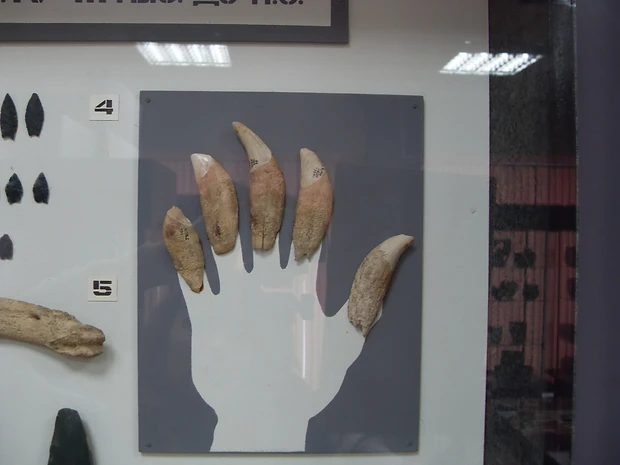
and symbols. The use of parts of totem animals or implements depicting them in dress decoration is a common practice among recent hunter-gatherer societies in Siberia. For example, a Yakut shaman (Altai) wore a costume which resembles a golden eagle, a leader (Lönnquist 1986: 84; Siikala 2002: 44). The Nganasan shaman’s costume had motifs of the most powerful birds (Taksami 1998: 21).

- another shaman in Bolshemys culture where R1b-p297 was found recently
833645_bf93038edbe4911247f1ff32304def35.png

833645_58ae488e246e0a6e5b3be47e8b5de0fc.webp


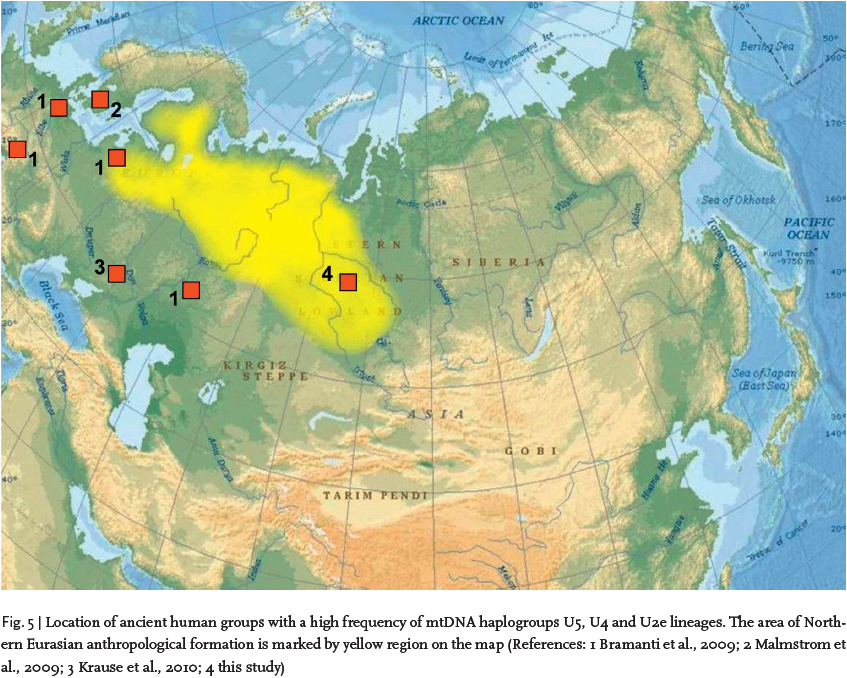
==> I think Narva and Bolshemys culture belong to the yellow zone

U2e-U4-U5region.png


V. Bunak identified one of unconsolidated complexes in varying anthropological variations in the Eurasian north-western forest zone as a separate racial community, which he called “Northern Eurasian Anthropological Formation” (Bunak, 1956, p. 101). To that anthropological community belong the Neolithic population groups of the Baraba steppe adjacent to the Altai-Sayan upland (Creek, Sopka-2/1)
The area of the Northern Eurasian Anthropological Formation enormous area: the main finds were obtained in the north-western (Onega lake, southern basin of the White Sea, Karelia, Baltics) and southeastern (northern Baraba) fringes, and also in the northern forest zone of the East European Plain (Pit–Comb Ware Cultural-Historical Community)

I think the ancient people in the yellow zone were intermediate between caucasoid and mongoloid.
They seems to have the following trait combinations, which continued to only modern Karelians. Those combinations have make russian anthropologists to be confused so far:
1. Mesobrachycrany/ a relatively short, wide, robust/ extremely high braincase.
2. The face : medium high and medium wide
3. The flattened upper horizontal facial profile, but the midfacial profile is sharp.
4. sharply protruding and convex nose.
 
And the Narva culture was connected to the neolithic Dvina region where recetly R1a and N1c were found
The main site, dating from the Early Neolithic, is Rudnya Serteiskaya, with two Early Neolithic cultures (Dolukhanov and Mikliaev 1989) . Rudnenskaya pottery of the middle phase exhibits some features characteristic ofthe Narva culture from the Baltic late phase which has parallels with the Upper Volga cultures, indicating that the region was a link between the Baltic and Upper Volga region
THE OCCUPATION HISTORY OF THE REGION BETWEEN THE DVINA AND LOVAT
RIVERS IN RELATION TO THE DYNAMICS OF ENVIRONMENTALCHANGE

http://eurogenes.blogspot.ca/2015/02/ancient-r1a1-and-n1c-from-western-russia.html
 
Ok so there were I2 and R1b in Narva culture. This was derived from Kunda culture and this one from the Swiderian around Poland. The first people to colonize the Baltic area so. From which refuge they came from? From Italy (Villabruna) or from the Balkans (the intervening region between Italy and Anatolia)?
These are the people who hunted and fished near the ice. They came from epigravittian I suppose.
 
Latvian hunter-gatherers were R1b-M269 (not just P297), has this been mentioned?:

http://www.biorxiv.org/content/biorxiv/early/2017/03/02/112714.full.pdf

http://www.anthrogenica.com/showthr...rom-the-Steppe&p=217483&viewfull=1#post217483

Saag et. al. 2017 said:
two Latvian hunter gatherer Y chromosomes have been characterized as belonging to R1b-M269 clade 39

Reference-39: Jones, E. R. et al. The Neolithic Transition in the Baltic Was Not Driven by Admixture with Early European Farmers. Curr. Biol. CB 27, 576–582 (2017).

Has this new Saag et. al. 2017 Estonian paper been discussed on Eupedia? I apparently missed the thread about it (assuming that there was one). There is also a Mittnik, Reich, Haak et. al. 2017 paper, "An eastern Baltic refugium of European hunter-gatherers."
 
Latvian hunter-gatherers were R1b-M269 (not just P297), has this been mentioned?:

http://www.biorxiv.org/content/biorxiv/early/2017/03/02/112714.full.pdf

http://www.anthrogenica.com/showthr...rom-the-Steppe&p=217483&viewfull=1#post217483


Reference-39: Jones, E. R. et al. The Neolithic Transition in the Baltic Was Not Driven by Admixture with Early European Farmers. Curr. Biol. CB 27, 576?€“582 (2017).

Has this new Saag et. al. 2017 Estonian paper been discussed on Eupedia? I apparently missed the thread about it (assuming that there was one). There is also a Mittnik, Reich, Haak et. al. 2017 paper, "An eastern Baltic refugium of European hunter-gatherers."

Are you sure they were M269+? I remember that Genetiker styled them as pre-M73... but I could be wrong...

This is the line of the reference, but I don't remember to have read about M269 in Jones' paper:

39. Jones, E. R. et al. The Neolithic Transition in the Baltic Was Not Driven by Admixture with Early European Farmers. Curr. Biol. CB 27, 576 (2017)
 
Are you sure they were M269+? I remember that Genetiker styled them as pre-M73... but I could be wrong...

This is the line of the reference, but I don't remember to have read about M269 in Jones' paper:

39. Jones, E. R. et al. The Neolithic Transition in the Baltic Was Not Driven by Admixture with Early European Farmers. Curr. Biol. CB 27, 576 (2017)
Actually, South and West Baltic saw the presence of EEF, but not the East side where Latvia is.
 
Back
Top